Cork in Bucket: Brain Teaser from Braingle
Question:
A cork, say from a wine bottle, is held by a robotic clamp at the bottom of a bucket of water and released the moment the bucket is dropped off the side of a tall building. What will happen to the cork during the fall? Will it float to the top of the bucket normally, slower than normal, faster than normal, or not at all? Assume that there is no air resistance to slow the bucket down.
HEY! DON'T JUST LOOK AT THE ANSWER! THINK ABOUT IT!
Answer:
The cork will stay at the bottom of the bucket and not float up at all during the fall, since the cork, the bucket and the water all fall at the same acceleration g (neglecting air resistance as all good physics questions do). The buoyant force of the water does not push the cork upward in this case since in free fall the buoyant force is zero. In other words, a cork only floats up when the water around it is heavier and pushes it up. In free fall the water is weightless, as is the cork and bucket, so there is no force to push the cork to the top of the bucket.
Snippets:
~~~~~~~
ARIN WHOIS Database Search by the American Registry for Internet Numbers: Find out who an IP address belongs to.
~~~~~~~
Video: Amelie (2001). w/ Audrey Tautou. In French with English subtitles. Introverted Paris girl spices up other people's boring life. Worth seeing!
~~~~~~~
Thursday, August 14, 2003

Tuesday, August 12, 2003
The 'Cavendish Experiment' can be used to determine the gravitational constant of the earth (G) using an apparatus (torsion balance) designed by geologist John Mitchell (1724-1793). It was first used and improved by Henry Cavendish (1731-1810) who, in 1798, used the results to calculate the average density of the earth. This allowed calculation of earth's mass ("weighing the earth") and G.
Other Links:
- The Mitchell-Cavendish Experiment by Laurent Hodges, Iowa State University.
- Measuring the Mass of the Earth by Donald G. York, Univ. Chicago; contains experimental setup and calculations. (requires Adobe Acrobat)
Sunday, August 10, 2003
Cork in Glass: Brain Teaser from Braingle:
Question:
If a cork is put into a glass of water, the cork will almost always drift to the side of the glass. There is one simple way, however, to get the cork to float on the surface in the center of the glass. What is it? Water, the glass, and the cork are all that is required.
HEY! DON'T JUST LOOK AT THE ANSWER! THINK ABOUT IT!
Answer:
The reason that a cork drifts to the side of a glass is that it floats to the highest point. Since water "clings" to the glass, the highest point is around the edge of the water. To get the cork to float in the middle of the glass, all you have to do is fill the glass as much as possible. The water will form a convex shape above the glass, with the highest point at its center. This is where the cork will settle.
Snippets:
~~~~~~~
Richard Feynman: Six Easy Pieces (Audio of physics lectures given in 1961/1962): When you take an apple and magnify it to the size of the earth, then the atoms in the apple are about the size of an apple.
~~~~~~~
Saturday, August 09, 2003
Notes to Book: Curt Suplee: Physics in the 20th Century (1999)
Laser = light amplification by stimulated emission of radiation
Precursor: Maser = microwave amplication by stimulated emission of radiation
Microwaves have longer wavelengths and therfore less energy than visible light
Einstein: Atoms can emit photons in two different ways: spontaneous (e.g., sun, light bulbs) and stimulated (maser, laser).
When an atom is excited by a quantum energy that exactly corresponds to one of its specific allowed energy states (postulated by Niels Bohr), it absorbs the energy, but then almost immediately sheds it by emitting a photon. Variation of effect: If an electron is already in an excited state and then struck be a photon of excactly the right energy, it emits two photons. The new photon is identical to the first; each quantum of radiation is perfectly matched, meaning the new photon is exacty in phase with the one that stimulated its emission: 'coherent'.
Snippets:
~~~~~~~
Video: "Cassatt" (Portrait of an Artist Volume 2: May Cassatt. Impressionist from Philadelphia. Produced by WNET/Thirteen for 'Women in Art' (1977), 30 min. Cassatt was, after Whistler, the most important American Impressionist Painter; she spent much time painting in Paris; she was a close friend of Degas; they thoroughly critiqued each others work; especially known for her mother-child portraits.
~~~~~~~
Video: Big. w/ Tom Hanks. A 13-year old boy makes a wish at a fair and slips into the body of a grown-up. Funny; childish at times; Hanks plays the role real well.
~~~~~~~
Brain-Teaser: The Flash Mind Reader. Can you find out how it works?
~~~~~~~
Design: Ritzenhoff (in German). Lots of pictures.
~~~~~~~
Designer: Michal Shalev, b. 1958 in Tel-Aviv, Israel; carpet and textile designs, also curtains, paper products, porcelain and shower curtains; has been working closely with such German firms as Ritzenhoff, Karstadt, Rosenthal, Design House since 1994.
~~~~~~~
Metric System Prefixes: Exta = 10^18, Peta = 10^15, Tera = 10^12, Giga = 10^9, Mega = 10^6, Kilo = 10^3
~~~~~~~
Monday, July 21, 2003
Coffee with Cream: Brain Teaser from Braingle
Question:
You are served a hot cup of coffee and room-temperature cream at a restaurant. You want to wait a few minutes before you drink the coffee, and you want it to be as hot as possible when you drink it. Should you pour the cream in the coffee:
a) Immediately
b) Just before you drink it
c) It doesn't matter
("don't add any cream" is not an option)
HEY! DON'T JUST LOOK AT THE ANSWER! THINK ABOUT IT!
Answer:
The driving force for heat transfer is temperature difference. The coffee by itself is very hot and will therefore cool down at a fast rate. Then once the cream is added the temperature will drop even more. If the cream is added immediately, then the temperature will drop initially but will then drop at a slower rate since the coffee with cream is cooler than the coffee alone and therefore the driving force for heat transfer is less. As an added bonus, adding the cream will increase the mass of the contents of the cup. A larger mass takes longer to cool down than a smaller one at the same temperature. Therefore, the cream should be added immediately.
Sunday, July 20, 2003
Notes to Book: Mortimer J. Adler: Aristotle for Everybody: Difficult Thought made Easy (1978):
- physical things: 3 dimensions: length, breadth, height; i.e., spatial dimensions, in which a body can move.
- human beings = persons: personal dimensions; i.e., directions, in which we can act as human beings: making, doing, knowing.
- making: man, the artist or artisan: producer of goods (shoes, houses, paintings).
- doing: man, the moral and social being; distinguish right and wrong, associate with other human beings.
- knowing: man, the learner; acquisition of knowledge about human nature and knowledge itself.
- man is a thinker in all these dimensions, but he thinks differently in each dimension.
- Aristotle speaks about:
- maker: 'productive thinking'.
- doer: 'practical thinking'.
- knower: 'speculative' or 'theoretical' thinking.
- Heraclitus: everything changes.
- Parmenides (and Zeno): everything remains constant.
- Aristotle: some things change, some remain the same.
- Euclid's geometry:
- definitions: points, lines, straight lines, triangles.
- axioms: cannot bew denied; confirmation cannot be avoided; "the whole is greater than the parts", "things equal to the same thing are equal to each other".
- postulates: assumptions that Euclid makes in order to prove the propositions that need proof "a straight line can be drawn from any point to any other point."
- Socrates was Plato's teacher, Plato was Aristotle's teacher.
- Socrates: an unexamined life is not worth living.
- Aristotle: an unplanned life is not worth examining, for an unplanned life is one in which we do not know what we are trying to do or why, and one in which we do not know where we are trying to get or how to get there. An unplanned life is also not worth living because it can not be lived well.
- A happy time is one filled with pleasures rather than pains, with satisfactions rather than dissatisfactions.
- "good" = desirable; "better" = more desirable; "best" = most desirable.
- Aristotle: these two notions -- good and desirable -- are inseparably connected; 'the good is desirable' and 'the desirable is good'.
- Moral virtue is the habit of making right choices. If the wrong choices greatly outnumber the right choices, one will steadily move in the wrong direction, away from achieving happiness instead of toward it.
- Aristotle was a great logican; he founded the science of logic.
Geometric Brain Teaser found on Aiyueh Kwan's Web Site: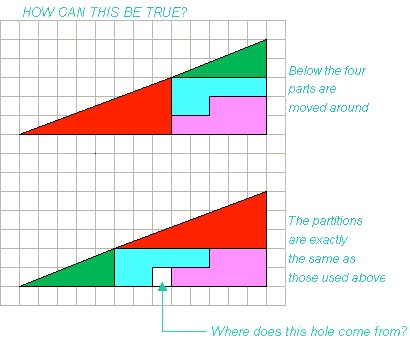
If you can't solve it, please send email to dynamicplanet@yahoo.com
Friday, July 18, 2003
Hermann Hesse in 'Siddhartha' (1922): "I can think. I can wait. I can fast."
Snippets:
~~~~~~~
Movie: The Fountainhad (1949); w/ Gary Cooper, Patricia Neal; directed by King Vidor; after the novel by Ayn Rand.
~~~~~~~
Talk: Richard Feynman: There's Plenty of Room at the Bottom (1959). Nanotechnology. Interesting to see, how small things can get.
~~~~~~~
Book on Tape: Richard P. Feynman: Six Easy Pieces (1994); Recordings of basic physics lectures that Feynman gave to Caltech undergrad students in 1961/1962; lectures resulted in Feynman's landmark book 'Lectures on Physics'.
~~~~~~~
Music: The Outlaws. Country Rock from the 70's. Single: 'Green Grass and High Tides'
~~~~~~~
Music: Tadd Dameron, jazz pianist; CD with John Coltrane: Mating Call; also included in the CD Box 'John Coltrane: The Complete Prestige Recordings'
~~~~~~~
Word: pizzicato: by means of plucking instead of bowing strings (Merriam Webster Dictionary)
~~~~~~~
Language: Grammar: Conjugation of German verbs: Institutio Steiger (in German)
~~~~~~~
Saturday, July 05, 2003
Tuesday, June 24, 2003
Hinduism: is based on Vedas, which are the oldest sacred writings of the Hindus (2000-1000 BC); more recent Vedas are called Upanishads (ca. 600 BC); in Indian (Vedic) philosophy it holds that: The Atman ("Self") which is Brahman ("World Soul"); Hindu philosophy further holds that this World Soul should itself be regarded as being the Three-in-One God known as the Trimutri: Brahma-the Creator, Vishnu-the Preserver, and Shiva-the Destroyer, are all perceived as being aspects or manifestations of the One-ness which is Brahman.
Snippets:
~~~~~~~
CD: Patricia Barber: Verse (2002)
~~~~~~~
Monday, June 23, 2003
Louisiana Purchase: Treaty signed April 20, 1803 in which the United States purchased the Louisiana Territory (2 million square kilometer, from the Mississippi River to the Rocky Mountains, for 60 million francs ($15 million). At first, France had ceded Louisiana to Spain in 1762, but the French had regained the area in the secret Treaty of San Ildefonso in 1800 under the rule of Napoleon Bonaparte. Napoleon envisioned a great French empire in the New World with the island Hispaniola (today: Haiti/Dominican Republic) as the heart of this empire. He therefore anticipated the Mississippi Valley to become crucial as a food and trade center. However, a rebellion of Haitian slaves and his soldiers struggling with yellow fever forced Napoleon to abondon the island, which also made Louisiana useless to him. In order to fund his military venture in Europe, he sold the territory to the United States in 1803.
The longest bridge in the world: The Second Lake Pontchartrain Causeway, which joins Mandeville and Metairie, Louisiana, USA, is 38.422 km (23 miles 1,538 yd) long. It was completed in 1969. The First Causeway Bridge was opened in 1956.
Snippets:
~~~~~~~
New Orleans' Oldest Candy Store: Laura's Candies; est. 1913
~~~~~~~
Other interesting artists featured at the Hanson Gallery, New Orleans: Edward Povey, Joanna Zjawinska, Joseph Lorusso.
~~~~~~~
Linnzi Zaorski: vocalist, New Orleans; strives to re-create the classic vocal stylings of 1920s and 30s era jazz legends.
~~~~~~~
Book: The Lost Continent: Small Towns in America by Bill Bryson; very funny, often sarcastic or ironic, describes author's experiences while traveling the U.S.; sometimes low density of information; often negative perception.
~~~~~~~
Book: Tanazaki Jun'ichiro: Lob des Schattes. Entwurf einer japanischen Aesthetik (1933, in German).
~~~~~~~
Book: Kenneth Blanchard and Spencer Johnson: The One Minute Manager (1983).
~~~~~~~
Book: Siegfried Lenz: Das schoenste Fest der Welt (1955 in German): book on tape; audio show.
~~~~~~~
Book: James Abbott McNeill Whistler: The Gentle Art of Making Enemies (1892, edition of 1967): reflections on art and art critics. Letters, newspaper clippings. Whistler drew plenty of butterflies for this book.
~~~~~~~
Book: Hermann Hesse: Siddhartha (1922, in German): condensed wisdom.
~~~~~~~
CD: John Coltrane: Stellar Regions (1967): free jazz; spiritual.
~~~~~~~
Movie: Trading Places (1983): w/ Dan Ackroyd, Eddie Murphy, Jamie Lee Curtis. Comedy. Two commodity brokers make a bet that they can turn a drug dealer into a successful businessman, and an honest employee into a criminal by mixing things up a little. But the two victims of the plot get their revenge. Funnny!
~~~~~~~
Actress: Jamie Lee Curtis (b. 1958): daughter of Janet Leigh (Psycho) and Tony Curtis (Some Like It Hot); starring roles in Halloween (1978), Trading Places (1983), A Fish Called Wanda (1988), and True Lies (1994).
~~~~~~~
Thursday, June 19, 2003
Adrian Deckbar: American, contemporary realistic artist; paintings and drawings are psychologically and emotionally charged; drama enhanced by strong lighting and unusual perspectives; similarity of paintings to Cindy Sherman's 'Untitled Film Stills'; represented by Hanson Gallery, New Orleans.
Other links: Adrian Deckbar: Diva Art Group
Snippets:
~~~~~~~
Einstein Documents: Einstein Archives Online
~~~~~~~
Movie: Duel (1971, TV); w/ Dennis Weaver. Man gets chased by a mystery truck, and fears for his life. Movie is very slow at times.
~~~~~~~
Juan Medina; super-realistic technique and surreal imagery; represented by Bryant Galleries, New Orleans.
~~~~~~~
Friday, June 06, 2003
Excerpt from 'In Blackwater Woods' by Mary Oliver (taken from: 'American Primitive', Pulitzer Prize in 1984)
Every year
everything
I have ever learned
in my lifetime
leads back to this: the fires
and the black river of loss
whose other side
is salvation,
whose meaning
none of us will ever know.
To live in this world
you must be able
to do three things:
to love what is mortal;
to hold it
against your bones knowing
your own life depends on it;
and, when the time comes to let it go,
to let it go.
Snippets:
~~~~~~~
Die Klage-Industrie (Der Spiegel, 17/2003, p122; in German): In the U.S. it has become very popular to sue companies for all kinds of things (drug side effects, open shoe laces, obesity, tobacco); class-action suits are especially profitable for lawyers; a 'culture of victims' is nurtured.
~~~~~~~
Vertigo (1958). Director: Alfred Hitchcock. Starring: James Stewart, Kim Novak, Barbara Bel Geddes. Ex-cop with acrophobia falls in love with apparently suicidal girl.
~~~~~~~
Book: Martin Milar: Die Elfen von New York (1996, in German). Two Scottish fairies turn New York City upside down.
~~~~~~~
Dynamic Planet Blog
TOC: Table of Contents
April 2003
1.) Arai Hakuseki's "Told round a brushwood fire..."
2.) Ludwik Fleck and Thomas Kuhn
3.) Albert Einstein
4.) Poetry of Sight, The Prints of James McNeill Whistler
5.) Lunar Eclipse
6.) Alexis de Tocqueville, Democracy in America
7.) The Structure of DNA
Tuesday, May 20, 2003
The Structure of DNA: The Double Helix (1986) by James D. Watson summarizes his personal views and experiences from the time in 1952/53 when he and Francis Crick raced against Linus Pauling to indentify the three dimensional structure of DNA. This book, though very subjectively written, and perhaps not entirely correct, is a gripping story of what led to the discovery of the 'Secret of Life'. Some people (e.g. Rosalind Franklin, a crystallographer who produced critical X-ray photographs of DNA) are presented unfavorably in the book, and there has been a large controversy as to whether Watsons 'personal account' is accurate. Also, Watson describes his own role in the work as having been there in the right place at the right time. Overall, the book is a thrilling story of how important discoveries in science are sometimes made.
Other facts and impressions from The Double Helix: Watson was working on viruses (phages), but DNA was always a side track that he was very passionate about; Crick was more the mathematician and model builder, Watson the visionary and driver of the enterprise; up to 1952 it was debated whether protein or DNA is the substance of genetic heredity; Pauling had published that proteins can fold into an alpha-helix structure; he has also published a triple-helix structure for DNA that proved to be incorrect.
The story, from the view of Linus Pauling, is also told on the web site Linus Pauling and the Race for DNA. It contains a narrative, a day-by-day personal account, hundreds of letters, manuscripts, photographs, published papers, and other media. Great resource!
The recent celebration of the 50th anniversary of the discovery of DNA structure yielded a large number of exhibitions and journal articles that recollect the events of early molecular biology. An exhibition at New York's Science, Industry and Business Library (New York Public Library), Feb. 24 - Aug. 24, 2003, displays crucial findings that led to the discovery, with special emphasis on the events in the New York area (Columbia, Rockefeller and Cold Spring Harbor Universities).
Notes from the exhibition:
- Friedrich Miescher (1844-1895) isolated DNA; elemantary analysis.
- Phoebus A.T. Levine: Book: Nucleic Acids (1931); was the first to isolate the carbohydrate portion of nucleic acids; distinguished DNA and RNA.
- Erwin Chagraff, Columbia Univ.: A and T, as well as C and G, occur in equal quantities (1:1) in all species.
- Oswald T. Avery, Colin MacLeod, and Maclyn McCarthy (Rockefeller, 1944): work with pneumococcus bacteria: DNA, not protein is the principle of life, i.e. carries the hereditary information; called the 'transforming principle'
- Max Dellbrueck (1906-1981), Salvador Luria (1912-1991): Phage Group at Cold Spring Harbor Laboratory (started 1945, peak late 1940s/early 1950s).
- Alfred Hershey (1908-1997) and Martha Chase (Cold Spring Harbor): using phages, they proved once more that DNA, not protein is the material of heredity. Experiment: Hershey and Chase labeled the protein component of phage with 35S-containing amino acids and the nucleic acid component with 32P; after infection of bacteria and centrifugation, 32P was found in cells, and 35S in the supernatant.
- John Kendrew (1917-1997), Max Perutz (1914-2002): formed the Medical Research Conuncil Unit for Molecular Biology at Cambridge University, UK. Here, Watson and Crick discovered the structure of DNA; Cavendish Laboratories.
- Linus Pauling, Californina Institute of Technology: had already worked on protein structures in 1948; proposed a triple helix structure for DNA before W. & C. suggested the double helix.
- Rosalind Franklin (1920-1958): took X-ray diffraction images of unprecedented high quality; worked at King's College, London, under Maurice Wilkins (1916-).
- Books: James Waton: The Double Helix (1968); Francis Crick: What Mad Pursuit (1988).
Sunday, May 18, 2003
Alexis Charles Henri Maurice Clérel de Tocqueville (1805-1859), an aristocratic Frenchman who travelled the United States in 1831 to study the American people and their political institutions; wrote 'Democracy in America', Volume I (1835) and Volume II (1840). It is one of the earliest and most profound studies of American life; concerns the legislative and administrative systems in the U.S. and the influence of social and political institutions on the habits and manners of the people.
Other Links:
Democracy in America, Online Version (HTML)
Democracy in America, Online Books (TXT, ZIP)
Toqueville.org
Snippets:
~~~~~~~
Blog Tracking: blo.gs
~~~~~~~
Papiertaschentuch-Sammlung (collection of tissues): over 1000 packets from many differnt countries (in German)
~~~~~~~
Friday, May 16, 2003
Monday, May 12, 2003
Notes to Exhibition: Poetry of Sight, The Prints of James McNeill Whistler (1834-1903) at the New York Public Library (see Dynamic Planet Blog, April 27, 2003):
- Seymor Haden: husband of W.'s half-sister
- Ruskin trial left W. bankrupt
- W. sometimes paid his bills with his art
- W. had at least two unacknowledged children
- portrait of W. by William Merrit Chase: painting each other; W. did not like C.'s picture
- W. had difficulties drawing hand and feet; often only sketched or left out
- W. liked to depict doorways in his prints
- W. had several mistress-modells / model-mistresses
- Venice and Thames sets are very serene, down to earth; great!
- The Gentle Art of Making Enemies: W. created over 100 different butterflies to comment upon text
- Drypoint: technique where fine needle is directly applied to plate
- W. had interest in lower class figures
- W. broke many friendships and relationships violently
- W. sometimes drew on plates that were used previously; sometimes figures and objects can be seen; W. then writes: 'Figures not mine' etc.
- Second Venice Set (1879/80) was inspired by Japanese prints
Snippets:
~~~~~~~
Synesthesia: Ramachandran and Hubbard, Scientific American May 2003, 53-59: explores linking of certain brain regions in synesthetes.
~~~~~~~
Notes to Boston: MIT; Newbury Street: galleries, shopping and restaurants; Copley Square: Trinity Church; Boston Public Library; Freedom Trail: Old State House
~~~~~~~
Betsy Ross: sewed the first American flag; house in Philadelphia
~~~~~~~
Saturday, May 10, 2003
Albert Einstein Exhibition at the American Museum of Natural History in NYC, Nov 15, 2002 - Aug 10, 2003. Notes to the Online Exhibtion:
May 29, 1919: solar eclipse proved that the Sun's gravity acts like a lens and deflects light from distant stars; confirmed Einsteins General Theory of Relativity.
LIFE
March 14, 1879: Albert Einstein born in Ulm, Germany; poor student, but excelled at math and science; taught himself geometry at the age of 12; embraced intellectual independence as a child;
January 6, 1903: Einstein marries Mileva Maric, a fellow physics student at the Swiss Federal Institute of Technology; daughter Lieserl born out of wedlock in 1902; Albert's passion for Mileva ran deep, but that didn't stop him from meeting other women when they were apart; Albert and Mileva divorced in 1919.
1905: Einstein (age 26) received his Ph.D. from the University of Zurich, publishes four groundbreaking articles in physics that were published in the prestigious journal 'Annalen der Physik'.
When Albert fell ill in 1917, his cousin Elsa Loewenthal nursed him back to health. He found her devotion endearing. Even before the couple married in 1919, Albert embraced Elsa's two daughters, Ilse and Margot, as his own children.
First job out of college as a patent clerk at the Swiss Federal Office for Intellectual Property in Bern.
Einstein's Nobel Prize (1921): He won the prize for his distinguished career in physics, most notably for his theory of light and electrons called the Photoelectric Effect (1905), not his more controversial theory of relativity.
Einstein never actually made it to Stockholm to accept his medal; Einstein was in the midst of a world lecture tour and headed to Japan when the Nobel telegram arrived at their Berlin residence in 1922. The German ambassador to Sweden attended the December award ceremony on Einstein's behalf, overlooking that the scientist had renounced his German citizenship in 1896. After much confusion over whether Einstein was a German or Swiss citizen, the Swedish ambassador hand-delivered the medal to Einstein in Berlin in 1923. Later that year Einstein visited Sweden to give his "Nobel lecture"— on relativity. With the medal came a sum of 121,592 kronor (roughly $32,000), which Einstein gave to his ex-wife Mileva as part of their divorce agreement.
LIGHT
1905: light always travels at a constant speed (300,000 km/sec = 186,000 miles/sec)); 'ether' to speed up light or slow down does not exist; light from a moving source has the same velocity as light from a stationary source.
1887: Albert Michelson and Edward Morley (both American scientists): Interferometer; they hoped it would enable them to prove the existence of the ether. Michelson and Morley ran their interferometer experiment numerous times but never saw any evidence of the ether.
The Michelson-Morley interferometer works by splitting a single beam of light in two. The two beams bounce off mirrors and arrive at a detector. If the ether existed, it would remain still while the Earth moved through it. The ether would then change the speed of light depending on whether the light was moving in the direction of Earth's motion or at a right angle to that motion. Michelson and Morley expected to find that two light beams arrived at the detector at different times. Instead they found that no matter which direction light traveled, it always moved at the same speed—indicating that the ether does not exist.
How long does it take to get to the Moon? Light travels the 380,000 kilometers (240,000 miles) between the Moon and the Earth in 1.3 seconds; Electron: 2.9 minutes; space shuttle (orbital speed): 14 hours; sound (70 F): 13 days; passenger jet: 18 days; NYC subway car (maximum speed): 220 days; human (walking): 9 years
Why can't you travel faster than light? The faster an object travels, the more massive it becomes. As an accelerating object gains mass and thus becomes heavier, it takes more and more energy to increase its speed. It would take an infinite amount of energy to make an object reach the speed of light.
TIME
Q: If the speed of light is constant, how could different observers measure the same speed for light when the observers themselves were moving at different speeds? For speed to remain constant, intervals of time and distance would have to change...
A: Time is not absolute; despite our common perception that a second is always a second everywhere in the universe, the rate at which time flows depends upon where you are and how fast you are traveling. Time does not progress at the same rate for everyone, everywhere. Instead, Einstein showed that how fast time progresses depends on how fast the clock measuring time is moving. The faster an object travels, the more slowly time passes for that object, as measured by a stationary observer.
Earth are traveling at 107,000 kilometers (67,000 miles) an hour around the Sun.
Different 'frames of reference' are defined in part by speed. In the Special Theory of Relativity, Einstein determined that time is relative—in other words, the rate at which time passes depends on your frame of reference. The effect of time slowing down is negligible at speeds of everyday life, but it becomes very pronounced at speeds approaching that of light.
Hypothetical 'light clock' experiment: Imagine a clock that consists of a pulse of light and two mirrors, one at the top of the clock and one at the bottom. The clock "ticks" when the pulse reaches the mirror at the top of the clock. and "tocks" at the bottom. The pulse bounces back and forth between the mirrors at a constant rate. When the clock moves, the time between ticks is longer. (diagonal path).
Effect is only detectable at high speeds: two highly accurate atomic clocks, flew one around the Earth aboard an airplane. When the airborne clock returned to Earth, it was a tiny fraction of a second behind the one that remained on the ground.
Intriguingly, someone moving will not think that their clock is running slow, because everything in that frame of reference will have slowed down as well. According to a stationary observer in space watching Earth move around the Sun, all of the clocks on our planet are running slow, yet we don't notice anything out of the ordinary.
A very fast spaceship is a time machine to the future. Five years on a ship traveling at 99 percent the speed of light (2.5 years out and 2.5 years back) corresponds to roughly 36 years on Earth!
The fastest spaceships of today travel at only 0.00004 % the speed of light. The most cutting-edge proposals for new engine technology would enable humans to travel at 0.1 percent the speed of light. Time travel—at least to the future—is theoretically possible, according to Einstein's Theory of Relativity. (Time travel to the past remains impossible.)
Cosmonaut Sergei Avdeyev spent a total of 748 days on the Russian space station Mir. Because Mir was moving relative to Earth, it was also a time machine. Avdeyev is 0.02 seconds younger than he would have been had he never traveled in space.
ENERGY
For centuries, scientists thought that matter could not be created or destroyed—it could only change form. The same idea seemed to apply to energy. Einstein: Mass and energy are different forms of the same thing: E=mc2
GRAVITY
Einstein postulated: gravity and acceleration are equivalent (equivalence principle); this idea was the seed that—over the next nine years— became the 'General Theory of Relativity'.
4-D Space-Time: Space and time make up the four-dimensional arena in which all things exist. Space-time valleys create the effect of gravity. So, the bowl-shaped warp made by Earth's mass, for example, alters the course of an object, like a satellite, that travels into that warp.
Snippets:
~~~~~~~
Model, writer: Sophie Dahl, granddaughter of writer Roald Dahl; book: The Man with the Dancing Eyes (Der Spiegel Nr. 19, 2003, 5.5.03 (in German))
~~~~~~~
More Models: Storm Models
~~~~~~~
Photography: The Gateway to Astronaut Photography of Earth: Access to all photographs since 1961. Searchable. Example: NYC
~~~~~~~
CD: Art Blakey and the Jazz Messengers: Moanin' (1958)
~~~~~~
Saturday, May 03, 2003
Ludwik Fleck (1896-1961): Polish physician and philosopher; sociologically-oriented approach to the study of the evolution of scientific and medical knowledge. Book: Entstehung und Entwicklung einer wissenschaftlichen Tatsache: Einfuehrung in die Lehre von Denkstil und Denkkollektiv (in German, 1925; translation: Genesis and Development of a Scientific Fact).
Fleck introduced the term 'thought collective': "People exist who can communicate with each other, i.e., who think somehow similarly, belong, so to say, to the same thought-group, and people exist who are completely unable to understand each other and communicate with each other, as if they belong to different thought-groups (thought-collectives)." "Every thought-collective considers that the people who do not belong to it are incompetent." "...cognition must be considered as a function of three components: it is a relation between the individual subject, the certain object and the given community of thinking (Denkkollektiv) within the subject acts; it works only when a certain style of thinking (Denkstil), originating in the given community is used."
Thomas Kuhn (1922-1996): scientist and philosopher; Book: The Structure of Scientific Revolutions. Science is not a steady, cumulative acquisition of knowledge; instead, science is a series of peaceful interludes punctuated by intellectually violent revolutions ('paradigm shift'); a scientific revolution is a noncumulative developmental episode in which an older paradigm is replaced in whole or in part by an incompatible new one; during periods of 'normal science', the primary task of scientists is to bring the accepted theory and fact into closer agreement.
The passage in Arai Hakuseki's "Told round a brushwood fire: The autobiography of Arai Hakuseki" that I referred to recently (Dynamic Planet Blog, Jan. 27, 2003) goes like this:
"When winter began, the days were short, and sometimes the sun set before I had finished my task. I then took my desk out on to a bamboo veranda, facing west, and so finished my writing. Also, when practicing calligraphy at night, I would be overcome with sleepiness, so I secretly arranged with the man who waited on me to have him draw and set ready two buckets of water on the verandah. When I grew very drowsy, I would take off my clothes and pour first one bucket of water over me, dress again, and study. Although at first I felt awakend by the cold, after a while I became warm and sleepy again, so, once more, I would pour water over myself, as before. With the help of the second lot of water, I would get through the greater part of my task. This happend during the autumn and winter of my ninth year [1665]." (Translation by Joyce Ackroyd, 1979, p. 60)
Snippets:
~~~~~~~
Seeking the Secret of Life: The DNA Story in New York. Online Exhibition and Exhibition at the Industry and Business Library in New York City. Good overwiew.
~~~~~~~
Text ueber Text: Includes a nice collection of prose and poerty (in German).
~~~~~~~
Gedichtepool: Collection of poems (in German); well organized.
~~~~~~~
Thursday, May 01, 2003
The Karluk was the flagship in an Arctic expedition initially led by Vilhjalmur Stefansson, famous for his studies of Inuit culture, who hoped to find a last unexplored continent hidden under the cap of the North Pole. The story of Karluk's voyage is similar to that of Shackleton's Endurance (see Dynamic Planet Blog, Feb. 5, 2003), but was not quite as fortunate. "We did not all come back" begins the book written by Captain Robert (Bob) Bartlett, in which he tells his story of what happend to ship and crew in 1913/14.
The expedition was poorly organized, and when the Karluk got stuck in the ice in the winter of 1913, Stefansson is believed by some to have deserted his men, claiming he would go on a hunting trip, and vanishing on a 5-year expedition of his own. After his return to Canada in 1918 he was criticized by the government and the press for abandoning the ship, but he suggested the deaths were justified in the name of science and progress. Moreover, he blamed Captain Bartlett for the disaster.
After Stefansson did not return, Captain Bartlett carried the responsibility for the lives of the 22 men, most of them scientists insufficiently accustomed with the Arctic conditions, an eskimo woman and her two children aboard the Karluk. But he was determined to save their lives after the Karluk got crushed by the ice and sank. The Captain has had polar experience: he had commanded the Roosevelt under Admiral Peary, when Peary had made his try for the North Pole.
Bartlett maneuvered his party and their supplies to Wrangle Island, 200 miles off the Siberian coast, arriving there in March 1914. Because the others were too weak, he then decided to make the further trip alone only in the company of a young unmarried Inuit, Kataktovick, and the two successfully reached Siberia. Here, they were welcomed and helped by the native Chukches, and could organize a rescue mission of the other party members.
William Laird McKinlay was one of the scientist aboard the Karluk and the last surviving member of the expedition. He published his memories in 1976, some 60 years after the voyage. Some of his unpublished writings greatly influenced Jeniffer Niven's book 'The Ice Master', which is the most recent analysis of the events in the Arctic.
Vilhjalmur Stefanson (1879-1962) wrote some 24 books and more than 400 articles about the high north and its people. He was an ambitious and successful explorer. He soon became a public figure in North America and Europe, well-known for his description of the "Copper Eskimo" (a group of Inuit with unexpectedly European features), his discovery of new lands in the Arctic, and his anthropological approach to travel and exploration. Despite all his accomplishments, Stefansson's reputation was tarnished for his role in the tragedy of the Karluk. It still remains controversial whether he had indeed intentionally abandoned his ship and crew.
Other Links:
Photos of the Karluk and Bob Bartlett
Photo: The Karluk in Ice
The Fate of Those Aboad the Karluk
Article: The Intimate Arctic: The article studies Stefanssons writings on how he dealt with his Inuit companions and his intimate relations in the Arctic.
Jeniffer Niven Website
Other Arctic Expeditions
Enchanted Learning: Explorers
Books:
1.) Jennifer Niven, The Ice Master: The Doomed 1913 Voyage of the Karluk (2000)
Review: MostlyFiction
Review: The Frederick A. Cook Society
Review: MyShelf
2.) William Laird McKinlay, The Last Voyage of the Karluk: The Classic Memoir of an Artic Disaster (1976)
3.) Robert A. Bartlett: The Karluk's Last Voyage (1916)
Sunday, April 27, 2003
James Abbott McNeill Whistler (1834-1903): Painter, draughtsman, decorator, writer; born in America, raised in Russia; spent his adult life as an artist in Paris, London, and Venice; forged his own aesthetic philosophy, which he articulated through his images (prints, paintings) and writings; he produced over 600 etchings, drypoints, and lithographs (incl. Twelve Etchings from Nature = The French Set (1858), The Thames Set (1859), and First and Second Venice Sets (1879-80)). Book: Whistler wrote "The Gentle Art of Making Enemies". The New York Public Library shows Whistler prints (Poetry of Sight
Whistler Etching
Other Links:
Whistler Prints
Whistler Biography and Paintings
Art Encyclopedia: James McNeill Whistler
Snippets:
~~~~~~~
Jazz Vocals / Vocal Improvisation: Kyoko Kitamura: seen at 55 Bar, NYC, March 15, 2003; w/ Khabu and Mike McGinnis, and on April 19, 2003 at The Three Jewels Cafe, NYC, w/ Ras Moshe (on reeds). Very intriguing experimental vocalist.
~~~~~~~
Author: Jean Améry. Book: Jenseits von Schuld und Suehne. Bewaeltigungsversuche eines Ueberwaeltigten (in German). Jean Améry Biography.
~~~~~~~
CD: Fairground Attraction: Ay Fond Kiss
~~~~~~~


 Posts
Posts

