The last time a total solar eclipse visible from New York City (and Connecticut, Rhode Island) was on Saturday, January 24, 1925, just after 9 AM. It was a cold, clear day, and the city was covered by snow. Observers were stationed at every other intersection between 72nd and 135th Streets to determine the most southern part of the 'belt of totality'. Totality could only be observed above 95th to 97th Streets, so residents of Brooklyn, southern Queens, Staten Island, and much of Manhattan missed the full spectacle. Nevertheless, Millions of people witnessed the Eclipse. They crowded onto roofs, bridges, and the upper floors of skyscrapers. Open spaces in the city's northern reaches were mobbed by eclipse gazers, who braved the 9-degree cold to watch as the moon's shadow gradually cast the city into morning twilight. Streetlights across the city flickered to life. Skyscrapers blinked in empty streets. At the Bronx Zoo, herds of deer raced in panic. At 9:11, the sun disappeared completely. ''As the black ball of the moon settled over the fiery sphere of the sun, the brilliantly shimmering corona came into sharp relief against the dull sky.'' The sun reappeared about 30 seconds later.
Other Links:
Solar Eclipse Newsletter Vol 6(2), Feb. 2001 (requires Adobe Acrobat Reader)
Eclipse Home Page by NASA / Goddard Space Flight Center
Path of the 1925 solar eclipse at Dave Owen Home Page
Snippets:
~~~~~~~
Video: The Lion, the Witch, and the Wardrobe (1988). Wonderworks Family Movie. Award-winning BBC production. Very close to the book.
~~~~~~~
Three famous men died all died on the same day, on Friday, November 22, 1963: John F. Kennedy (assassinated), Aldous Huxley, and Clive Staples Lewis.
~~~~~~~
Monday, September 22, 2003

Saturday, September 20, 2003
Virgil (70-19 BC): The Aeneid (written 19 BC). A brief summary can be found here. The Aeneid is an ancient Roman Epic about the adventures of the Trojan hero, Aeneas, who was destined to go to Italy and set up a new kingdom after Troy fell to the Greeks. On his way, Aeneas encountered many problems, but through many trial and errors he completed his journey and became the true founding father of Rome. On his way one of the people Aeneas meets is Dido, the young Phoenician queen and builder of Carthage, who falls hopelessly in love with him.
Snippets:
~~~~~~~
Video: Moby Dick (1956). After the novel by Herman Melville; directed by John Huston; w/ Gregory Peck (Captain Ahab). The tale of hunting the White Wale.
~~~~~~~
Video: The Matrix (1999). w/ Keanu Reeves (Neo), Laurence Fishburne (Morpheus), Carrie-Anne Moss (Trinity). Finding out about the true nature of 'reality'.
~~~~~~~
Carrie-Ann Moss also played Natalie in the movie 'Memento' (2000).
~~~~~~~
Internet Broadway Database: Comprehensive history of shows produced on Broadway, including historical information about theatres.
~~~~~~~
Online Bible Study Aids: including online bible versions, commentaries, dictionanries and bible concordances.
~~~~~~~
Video: Wag the Dog (1997). Directed by Barry Levinson; w/ Dustin Hoffman, Robert De Niro, Anne Heche. Plot: Before elections, a spin-doctor and a Hollywood producer join efforts to "fabricate" a war in order to cover-up a presidential sex scandal (IMDB). Plot is a nice idea, but after a half hour becomes repetitive.
~~~~~~~
Book: C.S. (Clive Staples) Lewis: The Lion, the Witch, and the Wardrobe (1950). Oldest volume of 'The Chronicles of Narnia'. The four children (Peter, Susan, Edmund, and Lucy) enter the land of Narnia, and help the lion Aslan to free the country from the terror of the White Witch.
~~~~~~~
Book: Sue Townsend: Adrian Mole. From Minor to Major. The Mole Diaries: the first ten years (1991). Incorporating 'The Secret Diary of Adrian Mole Aged 13 3/4' (1982), 'The Growing Pains of Adrian Mole' (1984), 'True Confessions of Adrian Albert Mole' (1989), and 'Adrian Mole and the Small Amphibians' (1991?). First two parts are hillarious, don't bother with the rest.
~~~~~~~
Video: Monster's Ball (2001) w/ Billy Bob Thornton (Hank Grotowski) and Halle Berry (Leticia Musgrove; Academy Award Winner Best Actress). Directed by Marc Forster. Plot: A Death Row prison guard in the Southern US quits his job, then falls in love with the wife of a black man he has executed. Movie is breathtaking at times. Weird plot. Good movie!
~~~~~~~
Henry Purcell (1659-1695), one of England's greatest composers. Epoch: Middle Baroque. Opera: Dido and Aeneas. Purcell wrote only this one full opera, a short work supposedly designed for a girls' school.
~~~~~~~
Saturday, September 13, 2003
Notes to 'Apprentice to Genius' by Robert Kanigel (1985):
Chain of mentors
Sol Snyder was the youngest full professor in the history of Johns Hopkins Univ.; 'idea man', rarely working at the bench. Snyder has reputation of 'stealing' other researchers results; very competitive, always trying to scoop them; e.g., competition for publishing the enkephalin story first after hearing about it from a different froup at a conference. Snyders approach: do it quick, don't spend too much time on details; conflicts with Pasternak, who was opposite.
Julius Axelrod was at first a technician under Brody, then moved on to get his Ph.D.; always working at the bench; he discovered COMT; considered a pioneer of modern neuroscience; won Nobel Prize in 1970.
Candace Pert co-discovered opiod receptors by binding studies (1973); used the antagonist naloxone as ligand.
Pedro Cuatrecasas: discovered insulin receptor by binding studies.
The book opposes various scientific approaches:
Candace Pert one-liners:
Snyder/Pert: Choose your problem with exquisite care, distinguishing those that are merely interesting from those that are important as well.
Snyder: "One experiment in the lab is worth a week in the library." So don't think about it too much. Just get hysterial and do it!
Snyder, even years after working with Julius Axelrod, would sometimes ask: "What would Julie do?". He wouldn't waste time on the trivial or the impossible. He'd keep it simple. He'd do it fast. He'd take a flier.
Albert Lasker Award for Basic Biomedical Research; is the 'American Nobel Prize'; Snyder has won it in 1978 for the opiate/enkephalin story; Pert was upset because she was not included, even though it was her work. Pert wrote a book (Molecules of Emotion) which is largely autobiographical.
Robert Merton (1967/1968): The Matthew Effect in Science: "Them that has, gets"
Most important U.S. schools: Harvard, Columbia, Berkeley, Princeton.
Other Links:
Bernard B. ('Steve') Brodie:
NIH/Stetten Museum of Medical Research
International Society for the Study of Xenobiotics
Lasker Foundation
BASi
Julius Axelrod:
Profiles in Science/National Library of Medicine
Nobel E-Museum
NIH/Stetten Museum of Medical Research
Solomon Snyder
Candace Pert
Lasker Award
NIH/Stetten Museum of Medical Research
Snippets:
~~~~~~~
Database: Gene Knockouts from the online journal 'Frontiers in Bioscience', a non-profit organization created by scientists for scientists for fostering international scientific communication and for providing scientists, physicians and patients with a diverse array of information, tools and techniques.
~~~~~~~
Video: The X-Files (1998). w/ David Duchovny (Agent Fox Mulder), Gillian Anderson (Agent Dana Scully), Martin Landau (Alvin Kurtzweil, M.D.). Mulder and Scully try to unravel a conspriacy around a dangerous alien virus.
~~~~~~~
Sunday, September 07, 2003
Onur Guentuerkuen, Nature 421, 711 (13 Feb 2003): Adult peristence of head-turning asymmetry. A preference in humans for turning the head to the right, rather than to the left, during the final weeks of gestation and for the first six months after birth constitutes one of the earliest examples of behavioural asymmetry and is thought to influence the subsequent development of perceptual and motor preferences by increasing visual orientation to the right side. Interestingly, twice as many adults turn their heads to the right as to the left when kissing, indicating that this head-motor bias persists into adulthood. Of 124 kissing pairs, 80 (64.5%) turned their heads to the right and 44 (35.5%) turned to the left (ratio ~ 2:1), which is statistically significantly different from 50% (1:1). Funny, what some people do research on!
Saturday, September 06, 2003
The Soviet Army Memorial in Berlin was built shortly after World War II, long before the Berlin Wall was raised. However, the memorial to the Soviet forces ended up just West of the dividing line. The memorial is located adjacent to the German Reichstag which was the scene of heavy fighting during the Soviet capture of Berlin. It is flanked by two T34 tanks, said to be the first to reach Berlin. The curved structure itself is created from marble presumed to be taken from Adolph Hitler's Chancellery ("Reichskanzlei"). At its focal point is a bronze statue of a Soviet solder holding a child in one hand and a sword smashing a Nazi swastika in the other. The stones from Hitler's Chancellery are engraved with the Soviet sickle-and-hammer design along with quotes from Stalin. The monument was guarded around the clock by the Red Army until German reunification in 1990.
Other Links:
Berlin von A bis Z: Sowjetisches Ehrenmal (in German)
Snippets:
~~~~~~~
Video: Subway. The Empire Beneath New York's Streets. Hosted and narrated by Jack Perkins. A&E Home Video (1994). Documentary about the history of the NYC subway.
~~~~~~~
Timothy 'Tiggy' Ticehurst. Painter born in Kent, UK, in 1965. Lives and paints in NYC. Sells his art on the street near the Metropolitan Museum. Previously worked under the names Timot and Timotoo.
~~~~~~~
Restaurant: Blue Room. 1 Kendall Square, Cambridge, MA. Serves a world of ethnic entrees. Buffet-style brunch. Dinner.
~~~~~~~
Movie: The Perfect Storm (2000). Directed by Wolfgang Petersen; w/ George Clooney (Captain Billy Tyne), Mark Wahlberg (Bobby Shatford), Diane Lane (Christina 'Chris' Cotter; Bobby's girlfriend on shore), Mary Elizabeth Mastrantonio (Linda Greenlaw, fellow skipper). Fight of the Gloucester sword-fishing boat Andrea Gail against the 'storm of the century' that took place off the New England coast in 1991; book by Sebastian Junger; film is based on a true story (even though no member of the ship survived to tell the story).
~~~~~~~.
Video: The Lord of the Rings: The Fellowship of the Ring (2001). First volume of J.R.R. Tolkiens fantasy story. Movie is rather disappointing.
~~~~~~~
Music: Stina Nordenstam. Swedish singer; similarities with Anja Garbarek. Voice not particularly interesting, but music is intriguing through its strangeness. Stina's web site is very well designed. Requires Shockwave Flash plugin.
~~~~~~~
Music: Skin. Former singer of British punk band Skunk Anansie. Album: Fleshwounds. Softer than S.A.
~~~~~~~
Book search engine: Fetchbook. com. With price comparison. Used and new books. Good!
~~~~~~~
Jefferson Davis (1808 - 1889): Only president of the Confederate States of America
~~~~~~~
Video: The Civil War 1861-1865 (1991). Dan Dalton Productions. Dramatic recreation of events through use of historic still photographs and early cinematic dramatizations of the war. Story of the war is told within 90 min; some of the film clips are repeated on several occassions throughout the film.
~~~~~~~
Thursday, August 14, 2003
Cork in Bucket: Brain Teaser from Braingle
Question:
A cork, say from a wine bottle, is held by a robotic clamp at the bottom of a bucket of water and released the moment the bucket is dropped off the side of a tall building. What will happen to the cork during the fall? Will it float to the top of the bucket normally, slower than normal, faster than normal, or not at all? Assume that there is no air resistance to slow the bucket down.
HEY! DON'T JUST LOOK AT THE ANSWER! THINK ABOUT IT!
Answer:
The cork will stay at the bottom of the bucket and not float up at all during the fall, since the cork, the bucket and the water all fall at the same acceleration g (neglecting air resistance as all good physics questions do). The buoyant force of the water does not push the cork upward in this case since in free fall the buoyant force is zero. In other words, a cork only floats up when the water around it is heavier and pushes it up. In free fall the water is weightless, as is the cork and bucket, so there is no force to push the cork to the top of the bucket.
Snippets:
~~~~~~~
ARIN WHOIS Database Search by the American Registry for Internet Numbers: Find out who an IP address belongs to.
~~~~~~~
Video: Amelie (2001). w/ Audrey Tautou. In French with English subtitles. Introverted Paris girl spices up other people's boring life. Worth seeing!
~~~~~~~
Tuesday, August 12, 2003
The 'Cavendish Experiment' can be used to determine the gravitational constant of the earth (G) using an apparatus (torsion balance) designed by geologist John Mitchell (1724-1793). It was first used and improved by Henry Cavendish (1731-1810) who, in 1798, used the results to calculate the average density of the earth. This allowed calculation of earth's mass ("weighing the earth") and G.
Other Links:
- The Mitchell-Cavendish Experiment by Laurent Hodges, Iowa State University.
- Measuring the Mass of the Earth by Donald G. York, Univ. Chicago; contains experimental setup and calculations. (requires Adobe Acrobat)
Sunday, August 10, 2003
Cork in Glass: Brain Teaser from Braingle:
Question:
If a cork is put into a glass of water, the cork will almost always drift to the side of the glass. There is one simple way, however, to get the cork to float on the surface in the center of the glass. What is it? Water, the glass, and the cork are all that is required.
HEY! DON'T JUST LOOK AT THE ANSWER! THINK ABOUT IT!
Answer:
The reason that a cork drifts to the side of a glass is that it floats to the highest point. Since water "clings" to the glass, the highest point is around the edge of the water. To get the cork to float in the middle of the glass, all you have to do is fill the glass as much as possible. The water will form a convex shape above the glass, with the highest point at its center. This is where the cork will settle.
Snippets:
~~~~~~~
Richard Feynman: Six Easy Pieces (Audio of physics lectures given in 1961/1962): When you take an apple and magnify it to the size of the earth, then the atoms in the apple are about the size of an apple.
~~~~~~~
Saturday, August 09, 2003
Notes to Book: Curt Suplee: Physics in the 20th Century (1999)
Laser = light amplification by stimulated emission of radiation
Precursor: Maser = microwave amplication by stimulated emission of radiation
Microwaves have longer wavelengths and therfore less energy than visible light
Einstein: Atoms can emit photons in two different ways: spontaneous (e.g., sun, light bulbs) and stimulated (maser, laser).
When an atom is excited by a quantum energy that exactly corresponds to one of its specific allowed energy states (postulated by Niels Bohr), it absorbs the energy, but then almost immediately sheds it by emitting a photon. Variation of effect: If an electron is already in an excited state and then struck be a photon of excactly the right energy, it emits two photons. The new photon is identical to the first; each quantum of radiation is perfectly matched, meaning the new photon is exacty in phase with the one that stimulated its emission: 'coherent'.
Snippets:
~~~~~~~
Video: "Cassatt" (Portrait of an Artist Volume 2: May Cassatt. Impressionist from Philadelphia. Produced by WNET/Thirteen for 'Women in Art' (1977), 30 min. Cassatt was, after Whistler, the most important American Impressionist Painter; she spent much time painting in Paris; she was a close friend of Degas; they thoroughly critiqued each others work; especially known for her mother-child portraits.
~~~~~~~
Video: Big. w/ Tom Hanks. A 13-year old boy makes a wish at a fair and slips into the body of a grown-up. Funny; childish at times; Hanks plays the role real well.
~~~~~~~
Brain-Teaser: The Flash Mind Reader. Can you find out how it works?
~~~~~~~
Design: Ritzenhoff (in German). Lots of pictures.
~~~~~~~
Designer: Michal Shalev, b. 1958 in Tel-Aviv, Israel; carpet and textile designs, also curtains, paper products, porcelain and shower curtains; has been working closely with such German firms as Ritzenhoff, Karstadt, Rosenthal, Design House since 1994.
~~~~~~~
Metric System Prefixes: Exta = 10^18, Peta = 10^15, Tera = 10^12, Giga = 10^9, Mega = 10^6, Kilo = 10^3
~~~~~~~
Monday, July 21, 2003
Coffee with Cream: Brain Teaser from Braingle
Question:
You are served a hot cup of coffee and room-temperature cream at a restaurant. You want to wait a few minutes before you drink the coffee, and you want it to be as hot as possible when you drink it. Should you pour the cream in the coffee:
a) Immediately
b) Just before you drink it
c) It doesn't matter
("don't add any cream" is not an option)
HEY! DON'T JUST LOOK AT THE ANSWER! THINK ABOUT IT!
Answer:
The driving force for heat transfer is temperature difference. The coffee by itself is very hot and will therefore cool down at a fast rate. Then once the cream is added the temperature will drop even more. If the cream is added immediately, then the temperature will drop initially but will then drop at a slower rate since the coffee with cream is cooler than the coffee alone and therefore the driving force for heat transfer is less. As an added bonus, adding the cream will increase the mass of the contents of the cup. A larger mass takes longer to cool down than a smaller one at the same temperature. Therefore, the cream should be added immediately.
Sunday, July 20, 2003
Notes to Book: Mortimer J. Adler: Aristotle for Everybody: Difficult Thought made Easy (1978):
- physical things: 3 dimensions: length, breadth, height; i.e., spatial dimensions, in which a body can move.
- human beings = persons: personal dimensions; i.e., directions, in which we can act as human beings: making, doing, knowing.
- making: man, the artist or artisan: producer of goods (shoes, houses, paintings).
- doing: man, the moral and social being; distinguish right and wrong, associate with other human beings.
- knowing: man, the learner; acquisition of knowledge about human nature and knowledge itself.
- man is a thinker in all these dimensions, but he thinks differently in each dimension.
- Aristotle speaks about:
- maker: 'productive thinking'.
- doer: 'practical thinking'.
- knower: 'speculative' or 'theoretical' thinking.
- Heraclitus: everything changes.
- Parmenides (and Zeno): everything remains constant.
- Aristotle: some things change, some remain the same.
- Euclid's geometry:
- definitions: points, lines, straight lines, triangles.
- axioms: cannot bew denied; confirmation cannot be avoided; "the whole is greater than the parts", "things equal to the same thing are equal to each other".
- postulates: assumptions that Euclid makes in order to prove the propositions that need proof "a straight line can be drawn from any point to any other point."
- Socrates was Plato's teacher, Plato was Aristotle's teacher.
- Socrates: an unexamined life is not worth living.
- Aristotle: an unplanned life is not worth examining, for an unplanned life is one in which we do not know what we are trying to do or why, and one in which we do not know where we are trying to get or how to get there. An unplanned life is also not worth living because it can not be lived well.
- A happy time is one filled with pleasures rather than pains, with satisfactions rather than dissatisfactions.
- "good" = desirable; "better" = more desirable; "best" = most desirable.
- Aristotle: these two notions -- good and desirable -- are inseparably connected; 'the good is desirable' and 'the desirable is good'.
- Moral virtue is the habit of making right choices. If the wrong choices greatly outnumber the right choices, one will steadily move in the wrong direction, away from achieving happiness instead of toward it.
- Aristotle was a great logican; he founded the science of logic.
Geometric Brain Teaser found on Aiyueh Kwan's Web Site: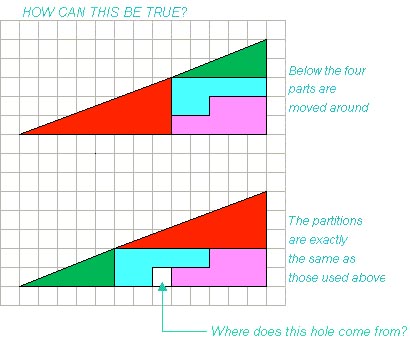
If you can't solve it, please send email to dynamicplanet@yahoo.com
Friday, July 18, 2003
Hermann Hesse in 'Siddhartha' (1922): "I can think. I can wait. I can fast."
Snippets:
~~~~~~~
Movie: The Fountainhad (1949); w/ Gary Cooper, Patricia Neal; directed by King Vidor; after the novel by Ayn Rand.
~~~~~~~
Talk: Richard Feynman: There's Plenty of Room at the Bottom (1959). Nanotechnology. Interesting to see, how small things can get.
~~~~~~~
Book on Tape: Richard P. Feynman: Six Easy Pieces (1994); Recordings of basic physics lectures that Feynman gave to Caltech undergrad students in 1961/1962; lectures resulted in Feynman's landmark book 'Lectures on Physics'.
~~~~~~~
Music: The Outlaws. Country Rock from the 70's. Single: 'Green Grass and High Tides'
~~~~~~~
Music: Tadd Dameron, jazz pianist; CD with John Coltrane: Mating Call; also included in the CD Box 'John Coltrane: The Complete Prestige Recordings'
~~~~~~~
Word: pizzicato: by means of plucking instead of bowing strings (Merriam Webster Dictionary)
~~~~~~~
Language: Grammar: Conjugation of German verbs: Institutio Steiger (in German)
~~~~~~~
Saturday, July 05, 2003
Tuesday, June 24, 2003
Hinduism: is based on Vedas, which are the oldest sacred writings of the Hindus (2000-1000 BC); more recent Vedas are called Upanishads (ca. 600 BC); in Indian (Vedic) philosophy it holds that: The Atman ("Self") which is Brahman ("World Soul"); Hindu philosophy further holds that this World Soul should itself be regarded as being the Three-in-One God known as the Trimutri: Brahma-the Creator, Vishnu-the Preserver, and Shiva-the Destroyer, are all perceived as being aspects or manifestations of the One-ness which is Brahman.
Snippets:
~~~~~~~
CD: Patricia Barber: Verse (2002)
~~~~~~~
Monday, June 23, 2003
Louisiana Purchase: Treaty signed April 20, 1803 in which the United States purchased the Louisiana Territory (2 million square kilometer, from the Mississippi River to the Rocky Mountains, for 60 million francs ($15 million). At first, France had ceded Louisiana to Spain in 1762, but the French had regained the area in the secret Treaty of San Ildefonso in 1800 under the rule of Napoleon Bonaparte. Napoleon envisioned a great French empire in the New World with the island Hispaniola (today: Haiti/Dominican Republic) as the heart of this empire. He therefore anticipated the Mississippi Valley to become crucial as a food and trade center. However, a rebellion of Haitian slaves and his soldiers struggling with yellow fever forced Napoleon to abondon the island, which also made Louisiana useless to him. In order to fund his military venture in Europe, he sold the territory to the United States in 1803.
The longest bridge in the world: The Second Lake Pontchartrain Causeway, which joins Mandeville and Metairie, Louisiana, USA, is 38.422 km (23 miles 1,538 yd) long. It was completed in 1969. The First Causeway Bridge was opened in 1956.
Snippets:
~~~~~~~
New Orleans' Oldest Candy Store: Laura's Candies; est. 1913
~~~~~~~
Other interesting artists featured at the Hanson Gallery, New Orleans: Edward Povey, Joanna Zjawinska, Joseph Lorusso.
~~~~~~~
Linnzi Zaorski: vocalist, New Orleans; strives to re-create the classic vocal stylings of 1920s and 30s era jazz legends.
~~~~~~~
Book: The Lost Continent: Small Towns in America by Bill Bryson; very funny, often sarcastic or ironic, describes author's experiences while traveling the U.S.; sometimes low density of information; often negative perception.
~~~~~~~
Book: Tanazaki Jun'ichiro: Lob des Schattes. Entwurf einer japanischen Aesthetik (1933, in German).
~~~~~~~
Book: Kenneth Blanchard and Spencer Johnson: The One Minute Manager (1983).
~~~~~~~
Book: Siegfried Lenz: Das schoenste Fest der Welt (1955 in German): book on tape; audio show.
~~~~~~~
Book: James Abbott McNeill Whistler: The Gentle Art of Making Enemies (1892, edition of 1967): reflections on art and art critics. Letters, newspaper clippings. Whistler drew plenty of butterflies for this book.
~~~~~~~
Book: Hermann Hesse: Siddhartha (1922, in German): condensed wisdom.
~~~~~~~
CD: John Coltrane: Stellar Regions (1967): free jazz; spiritual.
~~~~~~~
Movie: Trading Places (1983): w/ Dan Ackroyd, Eddie Murphy, Jamie Lee Curtis. Comedy. Two commodity brokers make a bet that they can turn a drug dealer into a successful businessman, and an honest employee into a criminal by mixing things up a little. But the two victims of the plot get their revenge. Funnny!
~~~~~~~
Actress: Jamie Lee Curtis (b. 1958): daughter of Janet Leigh (Psycho) and Tony Curtis (Some Like It Hot); starring roles in Halloween (1978), Trading Places (1983), A Fish Called Wanda (1988), and True Lies (1994).
~~~~~~~
Thursday, June 19, 2003
Adrian Deckbar: American, contemporary realistic artist; paintings and drawings are psychologically and emotionally charged; drama enhanced by strong lighting and unusual perspectives; similarity of paintings to Cindy Sherman's 'Untitled Film Stills'; represented by Hanson Gallery, New Orleans.
Other links: Adrian Deckbar: Diva Art Group
Snippets:
~~~~~~~
Einstein Documents: Einstein Archives Online
~~~~~~~
Movie: Duel (1971, TV); w/ Dennis Weaver. Man gets chased by a mystery truck, and fears for his life. Movie is very slow at times.
~~~~~~~
Juan Medina; super-realistic technique and surreal imagery; represented by Bryant Galleries, New Orleans.
~~~~~~~
Friday, June 06, 2003
Excerpt from 'In Blackwater Woods' by Mary Oliver (taken from: 'American Primitive', Pulitzer Prize in 1984)
Every year
everything
I have ever learned
in my lifetime
leads back to this: the fires
and the black river of loss
whose other side
is salvation,
whose meaning
none of us will ever know.
To live in this world
you must be able
to do three things:
to love what is mortal;
to hold it
against your bones knowing
your own life depends on it;
and, when the time comes to let it go,
to let it go.
Snippets:
~~~~~~~
Die Klage-Industrie (Der Spiegel, 17/2003, p122; in German): In the U.S. it has become very popular to sue companies for all kinds of things (drug side effects, open shoe laces, obesity, tobacco); class-action suits are especially profitable for lawyers; a 'culture of victims' is nurtured.
~~~~~~~
Vertigo (1958). Director: Alfred Hitchcock. Starring: James Stewart, Kim Novak, Barbara Bel Geddes. Ex-cop with acrophobia falls in love with apparently suicidal girl.
~~~~~~~
Book: Martin Milar: Die Elfen von New York (1996, in German). Two Scottish fairies turn New York City upside down.
~~~~~~~
Dynamic Planet Blog
TOC: Table of Contents
April 2003
1.) Arai Hakuseki's "Told round a brushwood fire..."
2.) Ludwik Fleck and Thomas Kuhn
3.) Albert Einstein
4.) Poetry of Sight, The Prints of James McNeill Whistler
5.) Lunar Eclipse
6.) Alexis de Tocqueville, Democracy in America
7.) The Structure of DNA
Tuesday, May 20, 2003
The Structure of DNA: The Double Helix (1986) by James D. Watson summarizes his personal views and experiences from the time in 1952/53 when he and Francis Crick raced against Linus Pauling to indentify the three dimensional structure of DNA. This book, though very subjectively written, and perhaps not entirely correct, is a gripping story of what led to the discovery of the 'Secret of Life'. Some people (e.g. Rosalind Franklin, a crystallographer who produced critical X-ray photographs of DNA) are presented unfavorably in the book, and there has been a large controversy as to whether Watsons 'personal account' is accurate. Also, Watson describes his own role in the work as having been there in the right place at the right time. Overall, the book is a thrilling story of how important discoveries in science are sometimes made.
Other facts and impressions from The Double Helix: Watson was working on viruses (phages), but DNA was always a side track that he was very passionate about; Crick was more the mathematician and model builder, Watson the visionary and driver of the enterprise; up to 1952 it was debated whether protein or DNA is the substance of genetic heredity; Pauling had published that proteins can fold into an alpha-helix structure; he has also published a triple-helix structure for DNA that proved to be incorrect.
The story, from the view of Linus Pauling, is also told on the web site Linus Pauling and the Race for DNA. It contains a narrative, a day-by-day personal account, hundreds of letters, manuscripts, photographs, published papers, and other media. Great resource!
The recent celebration of the 50th anniversary of the discovery of DNA structure yielded a large number of exhibitions and journal articles that recollect the events of early molecular biology. An exhibition at New York's Science, Industry and Business Library (New York Public Library), Feb. 24 - Aug. 24, 2003, displays crucial findings that led to the discovery, with special emphasis on the events in the New York area (Columbia, Rockefeller and Cold Spring Harbor Universities).
Notes from the exhibition:
- Friedrich Miescher (1844-1895) isolated DNA; elemantary analysis.
- Phoebus A.T. Levine: Book: Nucleic Acids (1931); was the first to isolate the carbohydrate portion of nucleic acids; distinguished DNA and RNA.
- Erwin Chagraff, Columbia Univ.: A and T, as well as C and G, occur in equal quantities (1:1) in all species.
- Oswald T. Avery, Colin MacLeod, and Maclyn McCarthy (Rockefeller, 1944): work with pneumococcus bacteria: DNA, not protein is the principle of life, i.e. carries the hereditary information; called the 'transforming principle'
- Max Dellbrueck (1906-1981), Salvador Luria (1912-1991): Phage Group at Cold Spring Harbor Laboratory (started 1945, peak late 1940s/early 1950s).
- Alfred Hershey (1908-1997) and Martha Chase (Cold Spring Harbor): using phages, they proved once more that DNA, not protein is the material of heredity. Experiment: Hershey and Chase labeled the protein component of phage with 35S-containing amino acids and the nucleic acid component with 32P; after infection of bacteria and centrifugation, 32P was found in cells, and 35S in the supernatant.
- John Kendrew (1917-1997), Max Perutz (1914-2002): formed the Medical Research Conuncil Unit for Molecular Biology at Cambridge University, UK. Here, Watson and Crick discovered the structure of DNA; Cavendish Laboratories.
- Linus Pauling, Californina Institute of Technology: had already worked on protein structures in 1948; proposed a triple helix structure for DNA before W. & C. suggested the double helix.
- Rosalind Franklin (1920-1958): took X-ray diffraction images of unprecedented high quality; worked at King's College, London, under Maurice Wilkins (1916-).
- Books: James Waton: The Double Helix (1968); Francis Crick: What Mad Pursuit (1988).
Sunday, May 18, 2003
Alexis Charles Henri Maurice Clérel de Tocqueville (1805-1859), an aristocratic Frenchman who travelled the United States in 1831 to study the American people and their political institutions; wrote 'Democracy in America', Volume I (1835) and Volume II (1840). It is one of the earliest and most profound studies of American life; concerns the legislative and administrative systems in the U.S. and the influence of social and political institutions on the habits and manners of the people.
Other Links:
Democracy in America, Online Version (HTML)
Democracy in America, Online Books (TXT, ZIP)
Toqueville.org
Snippets:
~~~~~~~
Blog Tracking: blo.gs
~~~~~~~
Papiertaschentuch-Sammlung (collection of tissues): over 1000 packets from many differnt countries (in German)
~~~~~~~
Friday, May 16, 2003
Monday, May 12, 2003
Notes to Exhibition: Poetry of Sight, The Prints of James McNeill Whistler (1834-1903) at the New York Public Library (see Dynamic Planet Blog, April 27, 2003):
- Seymor Haden: husband of W.'s half-sister
- Ruskin trial left W. bankrupt
- W. sometimes paid his bills with his art
- W. had at least two unacknowledged children
- portrait of W. by William Merrit Chase: painting each other; W. did not like C.'s picture
- W. had difficulties drawing hand and feet; often only sketched or left out
- W. liked to depict doorways in his prints
- W. had several mistress-modells / model-mistresses
- Venice and Thames sets are very serene, down to earth; great!
- The Gentle Art of Making Enemies: W. created over 100 different butterflies to comment upon text
- Drypoint: technique where fine needle is directly applied to plate
- W. had interest in lower class figures
- W. broke many friendships and relationships violently
- W. sometimes drew on plates that were used previously; sometimes figures and objects can be seen; W. then writes: 'Figures not mine' etc.
- Second Venice Set (1879/80) was inspired by Japanese prints
Snippets:
~~~~~~~
Synesthesia: Ramachandran and Hubbard, Scientific American May 2003, 53-59: explores linking of certain brain regions in synesthetes.
~~~~~~~
Notes to Boston: MIT; Newbury Street: galleries, shopping and restaurants; Copley Square: Trinity Church; Boston Public Library; Freedom Trail: Old State House
~~~~~~~
Betsy Ross: sewed the first American flag; house in Philadelphia
~~~~~~~


 Posts


